
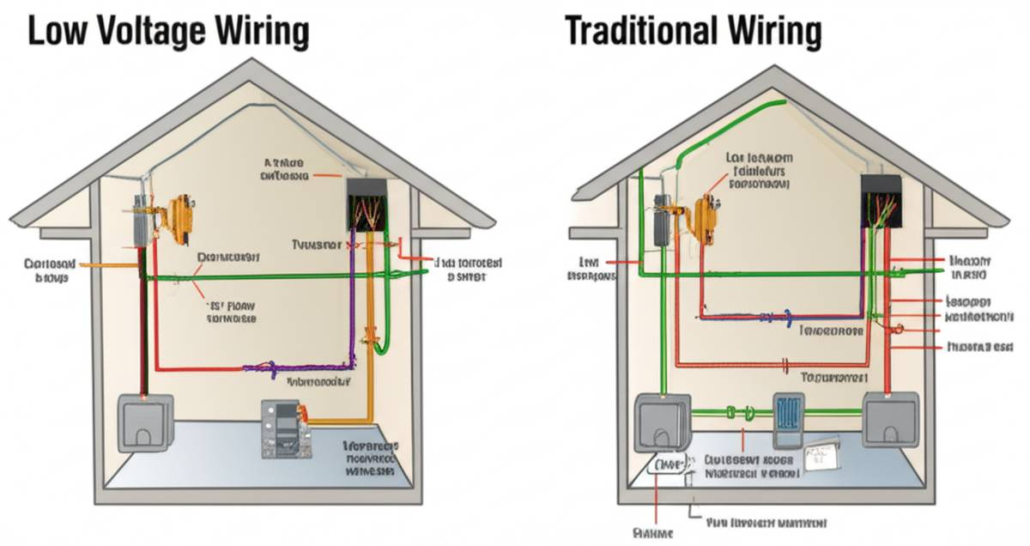
Choosing the right wiring for your home or business is essential for safety, efficiency, and functionality. Many homeowners and business owners are now considering low voltage vs. traditional wiring. PowerSol, the trusted low voltage provider in the GTA, is here to help you understand the key differences and make informed decisions. We proudly serve Toronto, Mississauga, Brampton, Vaughan, Markham, Richmond Hill, Oakville, and Milton.
Understanding Traditional (High Voltage) Wiring
Traditional wiring, often referred to as high voltage wiring, operates at 120V in North America. It’s the standard for powering most household appliances, lighting, and electrical outlets. This type of wiring uses thicker cables to handle the higher voltage and current.
Applications of Traditional Wiring
- Powering major appliances like refrigerators, ovens, and washing machines.
- General lighting throughout a building.
- Standard electrical outlets for plugging in devices.
Safety Considerations for Traditional Wiring
Working with traditional wiring requires caution and adherence to strict safety protocols. Because of the high voltage, there is a risk of electrical shock and fire. All installations and repairs should be performed by a licensed electrician.
Exploring Low Voltage Wiring
Low voltage wiring operates at a much lower voltage, typically 50V or less. It’s commonly used for applications that don’t require high power, such as security systems, network cabling, and some lighting. PowerSol specializes in low voltage solutions across the GTA. Considering security systems in Toronto? Low voltage may be the way to go!
Applications of Low Voltage Wiring
- Security systems (CCTV, access control, burglar alarms).
- Network cabling (Ethernet, data communication).
- Landscape lighting.
- Smart home devices (sensors, controllers).
- Audio-Visual systems.
Benefits of Low Voltage Wiring
- Safety: Reduced risk of electrical shock due to the lower voltage.
- Energy Efficiency: Low voltage systems often consume less power than their high voltage counterparts.
- Flexibility: Easier to install and modify, making it ideal for complex systems.
- Cost-Effective: Lower installation costs for certain applications.
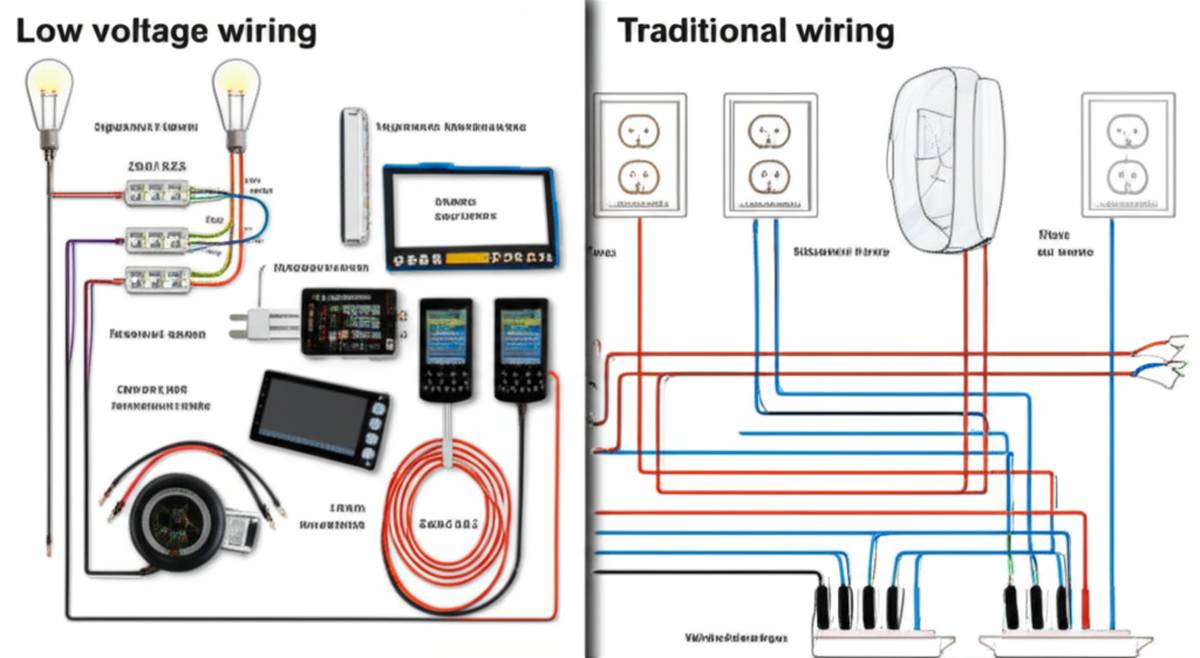
Key Differences: Low Voltage vs. Traditional Wiring
The core distinction lies in the voltage level. Traditional wiring carries high voltage (120V), while low voltage operates at 50V or less. This difference impacts safety, applications, and installation requirements.
Voltage Levels
- Traditional Wiring: 120V (North America)
- Low Voltage Wiring: 50V or less
Safety
- Traditional Wiring: Higher risk of electric shock and fire. Requires professional installation.
- Low Voltage Wiring: Lower risk of electric shock. Some installations can be done by homeowners, but professional assistance is still recommended, especially for complex systems.
Applications
- Traditional Wiring: Powers high-power appliances, general lighting, and standard outlets.
- Low Voltage Wiring: Powers security systems, network cabling, landscape lighting, smart home devices, and some lighting applications.
Installation
- Traditional Wiring: Requires licensed electricians and strict adherence to electrical codes.
- Low Voltage Wiring: Simpler installation process, but professional expertise is still recommended for optimal performance and safety. PowerSol offers expert network cabling in Toronto and surrounding areas.
Cost
- Traditional Wiring: Higher material and installation costs.
- Low Voltage Wiring: Lower material and installation costs for specific applications.
Choosing the Right Wiring for Your Needs
The best choice depends on the specific application. For high-power appliances and general lighting, traditional wiring is necessary. For security systems, network cabling, and smart home devices, low voltage wiring offers numerous advantages. PowerSol can assess your needs and recommend the optimal solution.
Considerations for Homeowners
- Security: Low voltage wiring is ideal for security cameras, alarm systems, and access control.
- Smart Home: Low voltage systems are used for smart lighting, smart thermostats, and home automation. Smart Home Solutions by PowerSol can transform your living space.
- Networking: Low voltage cabling is essential for reliable internet connectivity.
Considerations for Businesses
- Security: Low voltage wiring is critical for commercial security systems, including CCTV and access control.
- Networking: Robust network cabling is essential for business operations.
- Audio-Visual: Low voltage systems power conference room AV equipment and video walls.
PowerSol: Your Trusted Low Voltage Provider in the GTA
PowerSol is a leading provider of low voltage services in the Greater Toronto Area (GTA). We offer a comprehensive range of solutions, including security systems, network cabling, audio-visual systems, and smart home solutions. Our experienced technicians are committed to providing exceptional service and ensuring the safety and reliability of your systems. Contact us today for a free consultation.
Whether you’re looking to upgrade your home’s security system or install a new network for your business in Mississauga, PowerSol has you covered. We service Toronto, Mississauga, Brampton, Vaughan, Markham, Richmond Hill, Oakville, and Milton.
For more information on electrical wiring, you can visit Wikipedia’s article on electrical wiring.
FAQ: Low Voltage vs. Traditional Wiring
- What are the main advantages of using low voltage wiring?
- Low voltage wiring offers several benefits, including increased safety due to the lower risk of electrical shock, energy efficiency, flexibility in installation, and cost-effectiveness for specific applications like security systems and smart home devices.
- Is low voltage wiring safe to install myself?
- While low voltage wiring is generally safer than traditional wiring, it’s still recommended to hire a professional for complex installations. Incorrect wiring can lead to system malfunctions or even safety hazards. PowerSol’s expert technicians can ensure your low voltage systems are installed correctly and safely.
- Can I use low voltage wiring for all my electrical needs?
- No, low voltage wiring is not suitable for powering high-power appliances or general lighting that requires 120V. Traditional wiring is still necessary for these applications. Low voltage wiring is best suited for specific applications like security systems, network cabling, smart home devices, and some lighting applications.
Conclusion
Understanding the differences between low voltage vs. traditional wiring is crucial for making informed decisions about your electrical systems. Low voltage solutions offer enhanced safety and efficiency for various applications. PowerSol is your trusted partner in the GTA for all your low voltage needs. Contact us today to learn more!


Leave a Reply
Want to join the discussion?Feel free to contribute!